In a previous post I had some issues with floating divs. I asked a CSS guru, and all that I had to do was set the height attribute on the floating divs to get it behaving as expected.
Thanks darkelf!
Floating div solved
Have I gone mad?
I'm busy putting together a web-based wallboard for a callcentre, and suddenly my prototype started going crazy. I'm doing all the layout with CSS, and it worked very well, until suddenly, it went crazy.
Before: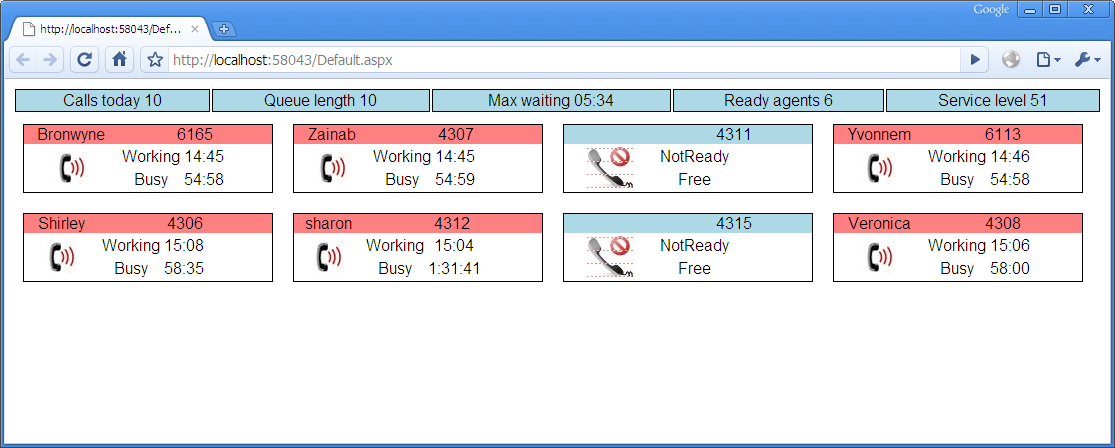
After:
As you can see, the floating divs are going horribly wrong. What did I change? The only change was to add a font-family attribute to the body class in the stylesheet, like this:
body
{
    font-family: Verdana, Arial;
}
Can any CSS or HTML guru explain to me why this happens? If I take away Verdana and leave Arial, it works in Chrome, I have to remove the whole font-family line for it to work in IE7.
Awaiting your comments...
Create new event log source
Normally ASP.Net does not have the required privileges to create an event log source, so you have to create one manually, or execute the creation code with the required privileges.
To sort out this little problem, there is a command line utility included in Windows called eventcreate. I've NEVER heard of this before, but apparently it has existed for a long time. It actually creates an event, but will create the specified event log source if called with the correct priviliges, like the Administrator account.
eventcreate /SO "MyApp" /D "MyMessage" /L Application /T ERROR /ID 999

SUCCESS: A 'ERROR' type event is created in the 'MyApp' log/source.
Filtering Out of Office notifications from rt (Request Tracker)
It's that time of the year again, where everyone has Out of Office replies set. One of our systems send out daily reports of files processed, and the Reply To address is set to the rt Queue address. This causes unnecessary requests being opened in rt for the Out of Office replies. What can one do?
Well, that's what I love about open source, procmail is your friend.
I found some references where people had exactly the same problem, so here is the solution I used based on those references.
Create/modify the procmailrc file (in my case it sits in /usr/local/etc/procmailrc).
QUEUE="$1"
ACTION="$2"

# Trash Outlook autoreplies
 :0 w
 * ^subject:.*Out of Office AutoReply
 /dev/null

 # Pass to rt
 :0 w
 |/usr/local/bin/rt-mailgate --queue $QUEUE --action $ACTION --url http://xx.yyy.zz/rt
The $1 and $2 variables are arguments passed to procmail, see the arguments after the -a command line switch below. These are stored in $QUEUE and $ACTION and passed to rt-mailgate in turn to make the solution more generic and reuseable.
Then I modified the postfix aliases file to pass all mail for the queue to procmail:
raxas-request: "|/usr/local/bin/procmail -a Raxas -a correspond"
Then remember to execute newaliases and postfix reload, and send some test mails.
Source links:
http://lists.bestpractical.com/pipermail/rt-users/2005-June/031855.html
http://www.beedub.com/cgi-bin/wiki.cgi/27
Ubuntu and 1.44mb floppy drive
A neighbour recently had a computer crash, and needed to get some files off floppy disks for her school. Luckily my old Athlon700 serving as a mythbuntu PVR still had a floppy drive.
I inserted the disk, and tried to mount it. It said the device did not exist. Huh? Then it dawned on me that the driver was possibly not loaded. I did some googling, and found out that you have to do a sudo modprobe floppy to load the driver before trying to mount it.
After I did that I was able to get all the files off the 3 disks and burned them onto CD. It was quite a trip down memory lane, I can't remember how many years it has been since I last used a floppy drive. Just the sound of the thing copying the files was almost foreign. And the speed, wow. We have become so used to USB flash drives. This was portable data back in the days.
Sidestepping those AutoRun USB viruses
I've had far too many people recently that got one of the AutoRun variants such as Conficker on their computers. Here is a tip on how to disable AutoRun (normally that window that pops up when you plug in a USB drive, but abused by Conficker and others to launch the viral code).
Click on Start / Run, type gpedit.msc and press Enter,
Then double-click Administrative Templates under Computer Configuration. Click on the System folder. In the right-hand side pane you should see Turn off AutoPlay. Double-click it, click on Enabled and make sure that All Drives is selected. Click Ok and close the Group Policy application.
Now whenever you plug in an infected USB drive it won't try to infect your PC right away.
Credit: http://www.howtogeek.com/howto/windows/disable-autoplay-of-audio-cds-and-usb-drives/
CLR Procedure, next iteration
We have code that uses an old Extended Stored Procedure written in Delphi that is giving some problems, so I decided to rewrite the procedure in C# as a CLR procedure.
The code has to download emails from a POP mailbox and process the attachments. For the POP code I found a nice POP library: http://dotnetctrlext.sourceforge.net/smtpop.htm
I had to exclude the MessageBuilder class from being compiled, as it was referencing System.Drawing, with which SQL Server has some issues, and I did not want to delve into them forever.
The first challenge was to register the CLR procedures. The database needs TRUSTWORTHY property set to ON, because the CLR procedure needs to be created with UNSAFE permissions as it accesses the network for the POP mail download.
This is the error it gives:
CREATE ASSEMBLY for assembly 'IntRegPopUtil' failed because assembly 'IntRegPopUtil' is not authorized for PERMISSION_SET = UNSAFE.
The assembly is authorized when either of the following is true: the database owner (DBO) has UNSAFE ASSEMBLY permission and the database has the
TRUSTWORTHY database property on; or the assembly is signed with a certificate or an asymmetric key that has a corresponding login with UNSAFE ASSEMBLY permission.
If you have restored or attached this database, make sure the database owner is mapped to the correct login on this server.
If not, use sp_changedbowner to fix the problem.
This is the change necessary:
ALTER DATABASE dbname SET TRUSTWORTHY ON
Next is creating the assembly:
create assembly IntRegPopUtil from 'C:\work\sandbox\IntRegPopUtil\bin\Debug\IntRegPopUtil.dll' with permission_set = UNSAFE
And the CLR Procedure:
create procedure IntRegPopProcessMail as external name IntRegPopUtil.[IntRegPopUtil.IntRegBulkMail].ProcessMail
Now we are ready to execute the procedure.
If you get an error like the following when executing your procedure, you need to create the assembly with UNSAFE permissions, as above.
A .NET Framework error occurred during execution of user-defined routine or aggregate "IntRegPopProcessMail":
System.Security.SecurityException: Request for the permission of type 'System.Net.DnsPermission, System, Version=2.0.0.0, Culture=neutral, PublicKeyToken=b77a5c561934e089' failed.
System.Security.SecurityException:
   at SmtPop.POP3Client.Open(String pop3host, Int32 port, String user, String pwd)
   at IntRegPopUtil.IntRegBulkMail.ProcessMail()
The next challenge was to get my code to be able to read its appSettings from sqlservr.exe.config in the SQL Server Binn folder.
You have to restart SQL after creating the sqlservr.exe.config in the same folder as sqlservr.exe. Then the fun starts.
It kept on giving error like the following:
"The value of the property 'key' cannot be parsed.
* The error is: Request failed. (sqlservr.exe.Config line X)".
This seems to be a bug from SQL2005 beta days, the solution is to add a dummy call to the ConnectionStrings property, this causes it to initialize properly. I found the solution here.
int i = ConfigurationManager.ConnectionStrings.Count;
That's it, now the procedure can connect to the POP server to download the mail, and it can use settings from the <appSettings> section in the sqlservr.exe.config.
To update the assembly when you've made changes to the dll, use the following syntax:
alter assembly IntRegPopUtil from 'C:\work\sandbox\IntRegPopUtil\bin\Debug\IntRegPopUtil.dll'
Subscribe to:
Posts (Atom)


